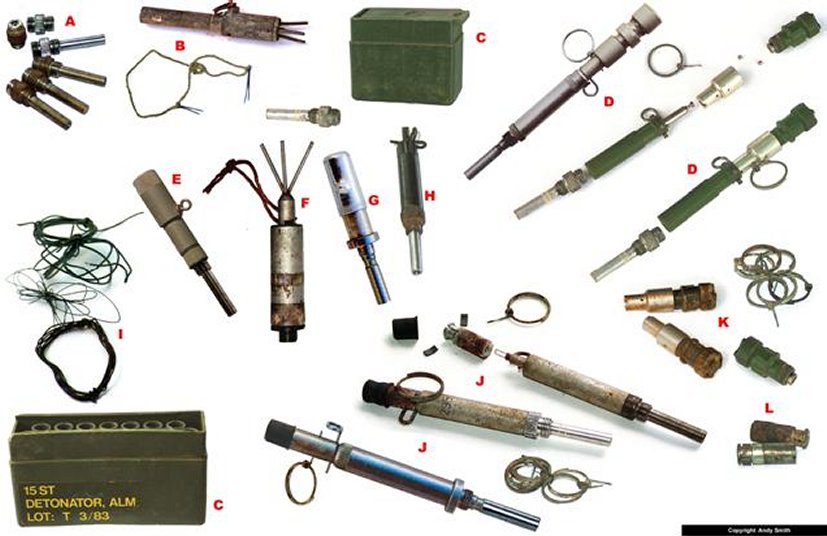
The picture illustrates some small fuzes and detonators.
A – These are initiator/detonator assemblies that screw to the end of the fuzes shown. In most cases they are “stab-sensitive” so are initiated by a pin or plunger stabbing into them.
B – This is a US M6/M7 pattern fuze with its arming pins on the string beneath it.
C – These are small plastic cases with a sliding top in which detonators for fuzes may be supplied.
D – These are MUV-4 fuzes. They are made of metal or green plastic. Like the MUV-2 and MUV-3 fuze, the MUV-4 has an arming delay so that the mine is not active immediately after the arming-pin is pulled. In this case the delay is the time it takes for the plunger to pull its way through a silicon gel and allow two small ball-bearings to escape. The end of the fuze then drops away and the mine is armed.
The two plastic fuzes shown have a small spring-clip attached to the firing pin and the fuze body. This makes the firing-pin more difficult to withdraw. The same clip can be found on some MUV-3 fuzes.
The stab sensitive detonator/initiator varies to match the thread used in different mines.
E – This UMP-2A fuze and detonator assembly is sometimes used with PMR fragmentation mines.
F – The RO-8 fuze with its arming pin still in place. This fuse is fired by pressure on the prongs and is often used with bounding fragmentation mines.
G – An MV-5 pressure operated fuze that is used in some anti-tank mines.
H – This is a black plastic RO-1 fuze that can be used in many cases where an MUV fuze would otherwise be used. It does not have an arming delay.
I – These are examples of the tripwires that may be used with many of the fuzes shown. Some tripwire is bare wire, some painted and some plastic coated.
J – These are MUV-2 fuzes. The MUV-3 varies only by having a small spring-clip attached to both the pin and the fuze body. The MUV-2 and MUV-3 fuze have an arming delay so that the mine is not active immediately after the arming pin is pulled. The delay is the time it takes for a thin wire on the end of the plunger to cut through a small strip of lead. The end of the fuze then drops away and the fuze is armed.
The stab sensitive detonator/initiator varies to match the thread required for different mines.
K – These are some of the pieces that drop away when an MUV-4 fuze is armed. A small pile of rusted MUV arming-pins is on the right.
L – These are some of the pieces that drop away when an MUV-2 or MUV-3 fuze is armed.
Suggested message(s):
1. Arming pins and detonator cases may be discarded when mines are laid.
2. Parts of most MUV fuzes fall away after an arming delay. These may be found by deminers when they are very close to the device.
3. Fuzes with a detonator attached can inflict severe injury.