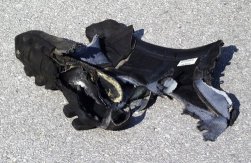
“a) laceration of the distal part of the sole of the right foot and multiple lacerations at the roots of the toes.
b) Fractures of bodies of all the metatarsals of the right foot.
c) Fractures of the proximal phalanges of the 1 st to the 4 th toes of the right foot.
d) Dislocation of the ankle with talus slipping forwards.”
The victim was operated on four times and has had subsequently physiotherapy. He kept his foot, got his compensation, and started a bakery.
The evidence of this accident (and the anecdotal evidence from the Sri Lankan army) appears to contradict the findings of the LEAP study… Perhaps there were reasons for the LEAP study’s findings to have been very reserved – leaving the reader to draw their own conclusions?
For those who don’t know, the US Department of Defence LEAP study involved testing a range of supposedly blast-resistant boots being worn on real legs – the limbs of cadavers. If you compare the LEAP results against the outcome of real events recorded in the Database of Demining Accidents there is a large discrepancy. The severity of injuries recorded in LEAP (and the predictions of subsequent surgical intervention that would be required) is consistently far worse than the evidence from real accidents. This implies that something was wrong with the way that the LEAP group drew conclusions, if not the testing methods.
I suspect that the testing methods were ill-conceived. The cadavers were of very old people and the frozen/thawed corpses had been cut about to fit pressure transducers internally. This may have made it inevitable that greater damage than was realistic would be recorded.
Or perhaps the error was introduced during the post-test assessment? The medical specialists may have been too strict about the need to amputate high to avoid infection following the blasts,
Alternatively, the explosive charges may not have accurately simulated mines.
Whatever the reason, the 'proof' that the LEAP study gives over the pointlessness of wearing blast-boots is brought into real question because its results do not come close to matching reality.
There may be a point in wearing blast boots (especially low-profile boots that do not make the wearer clumsy) in areas with very small blast mines… perhaps for survey, CASEVAC or even QC.
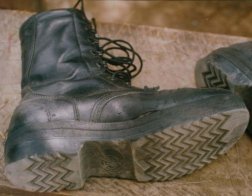
At one time I was working in Jordan in a mixed minefield where the mine most likely to be missed was the M14 - an AP mine with a very small metal content. The National Authorities wanted the deminers to wear blast boots - and they reluctantly complied. The BFR mine boots they used were low and lightweight. I refused to countenance wearing the BFR mine-boot which, in my opinion, offers false confidence and is no better than an ordinary work boot (which can also provide some protection against small mines). So when I was asked to assess the wearability of a better design, the AEGIS 100 mine boot, I agreed.
I used the AEGIS boots for three days while conducting my work in the minefield. No fee was payable, which made my assessment as independent as possible.
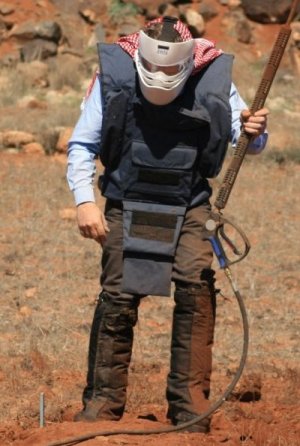
The boots provided comprised a lightweight inner 'slipper' of TABRE material, a rigid outer boot with high sole, and gaiters fitting on the boot and extending to the knee.
My previous work on all aspects of PPE, including foot protection, led me to accept that the high stand-off afforded by the boot's sole would provide significant protection against the blast associated with the M14 (containing less than 30g Tetryl). In the event of stepping on one of these while wearing the boots, I would expect injury to be reduced to simple broken bone(s) that could be treated without amputation. This expectation could not be tested, but did justify my decision to wear the boots during work inside this particular minefield.
I did not assess the blast performance of the sole or of the unique TABRE blast absorption material. My assessment was limited to the comfort and ergonomics of wearing the full assembly during work. To this end, on each occasion I wore the boots for a minimum of three hours and wore the complete products including “gaiters”. Other staff wore the low-soled alternative boot (BFR).
I first wore the full boot assembly in UK for one day while working. Much of my work was desk-bound. Every time I walked I was very conscious of the difference, but I found that I could walk easily and negotiate steps and slopes without a problem. The lack of a tight fit around the ankle did not lead to my foot 'slipping' inside the boot.